Thursday, October 22, 2009
Four Years Ago

Labels: cancer sucks, Laurianne, lung cancer
 Posted by Lynda ::
1:29 AM ::
---------------------------------------
Posted by Lynda ::
1:29 AM ::
---------------------------------------
Saturday, February 14, 2009
Lung cancer research deserves more funding
~~~~~~~~~~~~~~~~~~~~~~~~~~~~~~~~~~
My father smoked heavily for decades. Six years before his death, he decided to stop, but it was too late. The lungs have no nerve endings inside, so tumors can grow undetected. There they remain painless until symptoms like a persistent cough or breathlessness present.
In my father’s case, tumors spread to his shoulders, causing him intense pain. Eventually, a doctor pinpointed the cause of his discomfort. Less than six months later, he died at the age of 59.
I find it both alarming and offensive that no more funding goes toward lung cancer research now than when my father died in 1977, despite the fact that lung cancer kills more people than breast, prostate, colon, liver, kidney and melanoma cancers combined.
Health officials know that at least 164,000 new diagnoses occur each year. The amount of funding for lung cancer research remains an abysmal $1,829 for each lung cancer death compared to more than $23,000 for breast cancer and $14,300 for prostate cancer. Early detection programs and successful treatments for those latter two cancers mean anyone having either of them stands a good chance of surviving. Only about 14 percent of those diagnosed with lung cancer will overcome it.
When a dear friend of ours suffered from lung cancer last year, we were asked, “Did he smoke?” Apparently he did years ago, but hadn’t for decades.
It bothered me to hear that question as if it were an accusation: somehow he had brought his disease on by willful carelessness. Despite the fact that lung cancer is the most common cause of cancer death in our country, the “blame the victim” mentality persists.
My father heard that attitude from health care professionals. When Dad complained of a horrible sore throat, one asked, “What do you want when you abused your body like that?” Those who ask the question of whether a lung cancer victim smoked subscribe to the myth that it is a smoker’s disease, which it is not.
More than half of patients diagnosed with this type of cancer either never smoked or quit years earlier. People who never smoked account for between 15 percent and 20 percent of lung cancers. Of those 20,000 who never smoked and yet suffer from the disease, 80 percent are women. Some of these cases might be attributed to secondhand smoke. Researchers estimate 2,000 deaths result from that exposure each year.
But besides the effects of secondhand smoke, we have a large number of sufferers for which the cause remains elusive. And that number increases, especially among men and women in their 40s. More should be done to combat this disease. More aggressive screening is needed.
Perhaps, because there are no celebrity spokespersons for lung cancer, despite celebrity deaths from it like that of Dana Reeve, lung cancer is the poor step-child of cancers. People don’t want to talk about it, but we must.
More money must be funneled to lung cancer research to stop the carnage. It is horrible to watch a loved one die of cancer, and made more painful when so little is being done to fight this particular one. No one — smoker or nonsmoker — deserves to suffer from its ravages.
Obviously, funding for anything is made more difficult by our economic morass. But finding a cause and cure for lung cancer may save money in the end and stop families from suffering along with their suffering loved ones. It is too late for our friend.
Labels: bone cancer, Dana Reeve, funding, lung cancer, lungs, smoking cessation, suffering
Posted by Henry (Calem's Opa) ::
3:55 PM ::
---------------------------------------
Monday, November 03, 2008
Be Aware
October was Breast Cancer Awareness month. You probably saw it. Pink everywhere. Product packaging. Merchants asking for donations to the Susan G. Komen foundation.
November is Lung Cancer Awareness month. There will be no proclamations far and wide. In fact, many people won't even know that there is a month for Lung Cancer Awareness. But, if you are reading this, it means one more person is aware. Maybe you will tell your friends. Maybe they will tell their friends.
Lung cancer is a concern. Not just for smokers, like everyone wants to believe. Lung cancer is a concern for everyone.Labels: awareness, cancer, lung cancer
Posted by Lynda ::
7:09 PM ::
---------------------------------------
Monday, October 27, 2008
Graphic Cigarette Warnings
A few months ago, I came across some graphic cigarette warnings out of Canada. It really made me think for a moment. Why don't we have something like this?

If you are a smoker, or know a smoker, and you live in the United States, you have seen the plain jane warning on cigarette packages. It's something like this:

When I came across the graphic ads from Canada, I wondered if other countries did this as well. I found that there are 12 countries that have graphic cigarette warnings, including the UK, Brazil, New Zealand, and most recently Egypt. These ads show the various disadvantages to smoking. One warning, aimed at men, shows that cigarettes can cause impotence. Another shows young women that cigarettes will affect there unborn children. A third will tell you that that smoking can increase your chance of lung cancer by 80%.

Having watched someone I love go through lung cancer, even though it wasn't caused by cigarettes, I wouldn't wish it on anyone. The pain of not being able to breathe, the insidiousness of the cancer as it spreads through your body. Smoking increases your risk factor in getting lung cancer. Quitting smoking is such a preventable way lowering your risk in getting this disease. When you quit smoking, the benefits to you happen almost immediately. When you quit, your body will start to cleanse itself of the toxins. I have heard quitters say food starts to taste better after just a few days.

The American Cancer Society says this about quitting:
Immediate rewards of quitting
Kicking the tobacco habit offers some benefits that you'll notice right away and some that will develop over time. These rewards can improve your day-to-day life a great deal.
- your breath smells better
- stained teeth get whiter
- bad smelling clothes and hair go away
- your yellow fingers and fingernails disappear
- food tastes better
- your sense of smell returns to normal
- everyday activities no longer leave you out of breath (such as climbing stairs or light housework)

Quitting benefits not only the smoker, but the people around them who smoke. If we had graphic packaging in the United States, I wonder how many people would stop and think about what they are doing to there bodies. As I sit in the coffee shop, writing this article, I wonder if the two men sitting outside, smoking their cigarettes near the No Smoking by ordinance of the City of Santa Rosa sign would consider if smoking was worth the impotence risk, if the woman who bummed a cigarette from them would consider that smoking could increase the risk of SIDS to her future children, if the guy waiting smoking and waiting for the light to change would stop would lower his chance of having his family watch him suffer through some smoking disease or cancer.

Because right now, that little inconsipicious text box is pretty easy to ignore.
*This post is dedicated to my friend. Good luck on your journey! You will only be better for it.*
Labels: lung cancer, multiple myeloma, organizations, second-hand smoke, share a story, support
Posted by Lynda ::
3:50 PM ::
---------------------------------------
Saturday, March 29, 2008
A Doctor's Journey with Cancer
A Doctor’s Journey with Cancer
Saturday 29 March 2008
By Rusty Wright
When you suddenly learn you might have only 18 months to live, it’s a good time to sort out what really matters in life.
Last December, Yang Chen, MD, dismissed an aching pain under his shoulder as muscle strain. Five weeks later, as the pain persisted, a chest x-ray brought shocking results: possible lung cancer that might have spread.
A highly acclaimed specialist and medical professor at the University of Colorado Denver, Yang knew the average survival rate for his condition could be under 18 months. He didn’t smoke and had no family history of cancer. He was stunned. His life changed in an instant.
“I wondered how I would break the news to my unsuspecting wife and three young children,” he recalls. “Who would take care of my family if I died?”
Swirling Vortex of Uncertainty
When I heard his story, I felt a jab of recognition. In 1996, my doctor said I might have cancer. That word sent me into a swirling vortex of uncertainty. But I was fortunate; within a month, I learned my condition was benign.
Yang did not get such good news. He now knows he has an inoperable tumor. He’s undergoing chemotherapy. It’s uncertain whether radiation will help. Yet through it all, he seems remarkably calm and positive. At a time when one might understandably focus on oneself, he’s even assisting other cancer patients and their families to cope with their own challenges. What’s his secret?
I learned about Yang’s personal inner resources when we first met in the 1980s. He worked at the Mayo Clinic and brought me to Rochester, Minnesota, to present a seminar for Mayo and IBM professionals on a less ponderous theme, “Love, Sex and the Single Lifestyle.” With the audience, we laughed and explored relationship mysteries. He felt it was essential that people consider the spiritual aspect of relationships, as well as the psychological and physical.
Later he founded a global network to train medical professionals how to interact with patients on spiritual matters. Many seriously ill patients want their doctors to discuss spiritual needs and the profession is taking note.
Reality Blog
Now a patient himself, Yang exhibits strength drawn from the faith that has enriched his life. He has established a website – http://www.adoctorsjourneywithcancer.net/ – to chronicle his journey and “offer hope and encouragement to others.” The site presents a compelling real-life drama as it happens.
As a follower of Jesus, Yang notes biblical references to God’s “light shining in our hearts” and people of faith being “like fragile clay jars containing this great treasure.” He sees himself as a “broken clay jar” through which God’s light can shine to point others who suffer to comfort and faith.
As he draws on divine strength, he reflects on Paul, a first-century believer who wrote, “We are pressed on every side by troubles, but we are not crushed. We are perplexed, but not driven to despair.”
A dedicated scientist, Yang is convinced that what he believes about God is true and includes information about evidences for faith. He’s also got plenty to help the hurting and the curious navigate through their pain, cope with emotional turmoil, and find answers to life’s perplexing questions about death, dying, the afterlife, handling anxiety, and more.
With perhaps less than 18 months to live, Yang Chen knows what’s most important in his life. He invites web surfers to “walk with me for part, or all, of my journey.” If I’m ever in his position, I hope I can blend suffering with service while displaying the serenity and trust I observe in him. Visit his website and you’ll see what I mean.
© Assist News
Labels: doctors journey, lung cancer, Radon
Posted by Henry (Calem's Opa) ::
10:21 PM ::
---------------------------------------
Friday, March 28, 2008
Radon: The Silent Home Invader That Can Kill
By Dennis Thompson
HealthDay Reporter
Friday, March 28, 2008; 12:00 AM
FRIDAY, March 28 (HealthDay News) -- You can't see, smell or taste radon.
The gas emanates naturally from the soil, seeping up into homes that rest on the ground. The only way to avoid it, really, is to have a house on stilts.
But the radioactive gas is the leading cause of lung cancer among nonsmokers in America, as well as the second leading cause of lung cancer overall, according to the U.S. Environmental Protection Agency. It claims about 21,000 lives annually.
"It is a health risk you can't see," said Kristy Miller, spokeswoman for the EPA's Office of Radiation and Indoor Air. "You can't touch it, you can't feel it. It is an inert gas. It's in your home for a long time, leaving no trail of evidence. It's only your proactive interest and testing that's going to prevent this health risk."
Radon is a global problem -- the World Health Organization says radon causes up to 15 percent of lung cancers worldwide.
About one of every 15 homes in the United States is estimated to have a dangerous radon level, which the EPA defines as more than 4 picocuries per liter of air.
Radon is produced from the natural decay of uranium, an element found in nearly all soils. "The earth is always emitting radon at some level," Miller said. "It's always a part of the outdoor ambient air, in trace amounts."
The gas typically moves up through the ground to the air above and into your home through cracks and other holes in the foundation. The home then traps radon inside.
"A home over the soil can act as a holding tank, allowing radon to accumulate to high levels," Miller said.
When inhaled, radon can damage the lungs by continuing to emit tiny bursts of alpha radiation, she said.
"The alpha emitters can actually damage the DNA of the lung tissue," Miller said. "The lung is extremely sensitive, compared with the skin."
Any amount of radon exposure is bad, the EPA says, but the cancer risk increases over time, as exposure is prolonged.
Because a house's radon level depends on many variables -- the composition of the soil, the construction of the house -- experts warn that any house might have high levels of the gas.
"Even if you have a new home, you might have high radon," said Bruce Snead, an extension specialist at Kansas State University specializing in radiation and indoor air quality. "The only way to know is to test."
The EPA recommends that any homeowner should conduct a radon test. The tests are easy to obtain. They're sold at hardware stores, and some local health departments and extension services offer to sell them at cost to homeowners, Snead said.
"People can test a home on their own," he said. "All they have to do is purchase a test kit, and read and follow the instructions."
The U.S. Surgeon General has recommended that people test their homes for radon every two years, and retest any time they move, make structural changes to the home or occupy a previously unused level of a house.
Homeowners also can hire a radon expert to come in and test levels, an action that some states require as part of a home sale, Snead said. About 20 states have laws requiring notification of radon levels in real estate transactions, and more are considering it, he said.
"Just as lead is a required notification, should the same thing happen with radon?" Snead said.
If high levels of radon are discovered, a relatively low-cost home repair can alleviate the problem, Snead said. The EPA recommends hiring a qualified radon mitigation contractor to do the work, because lowering high radon levels requires specific technical knowledge and special skills.
The most common method of radon reduction is called soil suction. It prevents radon from entering your home by drawing the radon from below the house and venting it through a pipe, or pipes, to the air above the house where it is quickly diluted, Snead said.
"The pipe discharges above the roof line, so this well-known carcinogen will dissipate into the atmosphere," he said. The pipes can work either passively, or with a fan used to pull air from the soil.
The average cost of a radon reduction system is about $1,200, according to the EPA. The cost generally ranges from $800 to $2,500, depending on the characteristics of the house and choice of radon-reduction methods.
Some homes now are being built to be radon-resistant, with gas-resistant foundations and sub-slab fill materials that allow gases to move easily away, Snead said.
Snead recommends that everyone, homeowner or renter, be proactive in dealing with the radon that could be building up in their homes.
"We save lives by having tests done and performing mitigation, and by building houses that are radon-resistant," he said.
More information
To learn more, visit the U.S. Environmental Protection Agency
SOURCES: Kristy Miller, spokeswoman, U.S. Environmental Protection Agency's Office of Radiation and Indoor Air; Bruce Snead, extension specialist, Kansas State University, Manhattan
Labels: lung cancer, lungs, Radon
Posted by Henry (Calem's Opa) ::
11:53 PM ::
---------------------------------------
Tuesday, February 19, 2008
Some Cancer Patients Turn to 'Coaches'
Feb 18, 5:40 PM (ET)
By MARILYNN MARCHIONE
The advice made her head spin: Have the lump removed. No, let them take the whole breast. Chemo? Radiation? Everyone seemed to have an opinion.
"I just shut everyone down around me," said Bernie Brann, a newly diagnosed cancer patient from upstate New York. "You're just so overwhelmed with information."
Bad advice, or just too much of it, can compound the trauma and damage done by the disease itself, cancer patients often find. Friends and relatives are important for support, but when these untrained people act as cancer coaches, they can sway people to make poor decisions about their care.
This includes survivors, whose opinions are highly valued by patients suddenly facing the scary diagnosis. They may know a lot about cancer, but can do harm if they project their own experiences onto someone else, who may have a different form of the disease that needs different treatment.
Survivors also may be out of touch with changes in the field, where genetic discoveries are rapidly reshaping notions of who needs chemotherapy and what kind.
What's the solution?
Many advocacy groups and hospitals are using "professional" coaches - trained volunteers or paid workers who can objectively help new patients navigate the maze of information and options.
The American Cancer Society started a patient navigator program a few years ago that now operates in 87 locations and is planning to expand. The National Breast Cancer Coalition also trains coaches, and big treatment hospitals like the University of Texas' M.D. Anderson Cancer Center are increasingly using them for breast, prostate, lung and other types of cancer.
Attendance set records in December at one of the top training programs, held during the San Antonio Breast Cancer Symposium. More than 240 breast cancer survivors spent late nights at the convention center, taking notes as scientists schooled them on the latest research.
These women go home to volunteer in hospitals and support groups where they staff hotlines, meet with new patients and teach other coaches what they learned. Demand for this training is so great that the Alamo Breast Cancer Foundation gets grants from the Avon Foundation and nine drug companies to subsidize some attendees, but still can't meet the need. Dozens are turned down each year.
To find a coach or navigator, patients can ask their doctors, local cancer hospitals or groups like the cancer society for help. Brann, feeling a need for unbiased help, found a coach by calling the Cancer Resource Center of the Finger Lakes, where associate director Bob Riter provided it.
"People are usually too free about giving advice," said Riter (pronounced RITT-er), a survivor of male breast cancer and graduate of the San Antonio program. "We never tell people what to do. We provide information, and we help them think out loud."
Whether amateur or professional, a good cancer coach should offer these things, experts say:
_Support: an ear to listen, a shoulder to cry on, a hand to hold.
_Resources: reliable information or help getting it, and only if the patient wants it.
_Objectivity: a willingness to help patients discover what is best for them, rather than to validate the coach's own cancer battle and choices.
"There's a big difference in saying, 'This is what I did' and 'Here's what you should do,'" Riter said.
Elderly people are especially vulnerable to having their decisions usurped, he added. "Sometimes middle-aged kids impose what they want to do on their parents" without asking what the parent wants.
No hard numbers exist on how many cancer patients bring professional coaches or informal ones - a relative or friend - to doctor appointments where treatments are discussed.
"The person coming with you can either be an asset or a liability," said Meg Gaines, a lawyer and ovarian cancer survivor who runs the Center for Patient Partnerships, an advocacy resource at the University of Wisconsin-Madison.
It is good if the coach can ask questions, gather information and take notes for the shell-shocked patient to use later, she said. It is bad if the coach interferes with the patient's decisions.
Doctors often find themselves in the middle, fighting for the patient's trust. Some choices come down to personal values and risk tolerance, said Dr. C. Kent Osborne, a breast cancer specialist at Baylor College of Medicine in Houston.
Whether to have chemotherapy is an example. Some women want to avoid it at all cost. Others "don't want to leave any stone unturned," and demand it even if it has harmful side effects and only a 1 percent chance of helping, he said.
As for patients being swayed by others, "a lot of that occurs when they're not in the doctor's office and they go back to their home and their community," Osborne said. "Then well-meaning friends might say, 'Well, gee, I was treated with this and you should get that,' or 'Aunt Molly got this and you should get that, too,' not understanding that every patient is different."
Patients can fall into the same trap when they coach each other, Gaines said.
"This is the potential downside of support groups - you don't have expertise around the room," she said. "Someone may be describing her own treatment and others will think, 'My doctor didn't tell me that,'" possibly because their cancer is different.
Mary Michaud, policy director at the Wisconsin center, warns: "Beware of people who tell you your experience is going to be just like theirs."
Anna Cluxton, a Columbus, Ohio, woman diagnosed with breast cancer at age 32, feels strongly that she did the right thing having her whole breast removed rather than just the lump. When she coaches other young women whose doctors have advised less drastic surgery, she said she will not express an opinion, but suggests a pointed question: "Ask them, 'What will be my chances of recurrence in that same breast?'"
"You need to be aware of all the options" and discuss them fairly, she said.
Vira Brooks, an Omaha public schools administrator, had a different experience 13 years ago. Although she had a tiny, very early-stage tumor, her surgeon recommended removing the whole breast. She chose less drastic treatment after a survivor she knew coached her through looking at other options.
"She was basically my champion. She helped me navigate the system," Brooks said. "She listened, she shared with me what she had been through," but didn't try to tell her what to do.
Brooks now tries to do the same. She has coached dozens of patients, including black women like herself who are more likely to be diagnosed at later stages and are more likely to die from the disease. A local hospital refers people to her.
As for Bernie Brann, the patient from upstate New York, she did not seek a lot of advice when she was first diagnosed. But word got around at Ithaca College Health Center, where the 69-year-old woman works two nights a week as a nurse's aide.
Doctors told her she could either have a mastectomy or just the lump removed, and at first, she thought she would do the latter. "But I had so many people saying, 'No, no, no, that's not the way to go.' Most people said, 'Have a mastectomy.' It was so radical. It just overwhelmed me. It was not something I wanted to do."
She credits her three children with offering support without telling her what to do. Her oldest son went with her to appointments, as did a close friend with nursing training. Ultimately, she changed her mind about what would be best for her, and had a mastectomy in late December.
"I didn't want to go through this again. My feeling was, get in there, get rid of it, get on with your life," she said.
"It's been quite a rollercoaster," she said. But she feels more confident now that she can make good decisions about her future care.
---
On the Net:
American Cancer Society: http://www.cancer.org
Personalized treatment decision tool: http://tinyurl.com/2uvyu6
American Society of Clinical Oncology patient site: http://www.plwc.org
National Cancer Institute: http://www.cancer.gov
Treatment options: http://www.nccn.org/patients
Association of Cancer Online Resources: http://www.acor.org
Breast cancer support groups:
http://www.y-me.org
http://www.komen.org
http://www.bcaction.org
http://www.stopbreastcancer.orgLabels: cancer, chemotherapy, coaches, lung cancer, radiation, support
Posted by Henry (Calem's Opa) ::
2:10 PM ::
---------------------------------------
Wednesday, November 07, 2007
November - Lung Cancer Awareness Month
After a much published breast cancer awareness month in October we are a couple of days into November. November is the Lung Cancer Awareness Month and also Pancreatic Cancer Month. Below are some facts about lung cancer.
172,000 people will be diagnosed with lung cancer in 2008
163,000 Americans will die of lung cancer this year- equivalent to to the 9/11 attacks occurring 53 times in a year.
The average patient is diagnosed at around age 70, usually diagnosed with an advanced stage of lung cancer.
It is estimated that 50% of people diagnosed are smokers or former smokers who quit decades ago.
Lung cancer can occur in people who have never smoked.
Here are the cold facts about lung cancer - it's hard to find early and difficult to treat. I have learned it is one of the more miserable cancers to suffer from. However, lung cancer is also one of the most preventable types of cancer. That is the good news! By avoiding certain risk factors for lung cancer, we can reduce our chances of developing it. This is the first step in lung cancer prevention..The 5 ways to prevent lung cancer are:
1. Quit smoking - NOW
Smoking is the number one risk factor for lung cancer. It is estimated that 87% of lung cancer deaths are caused by smoking. As soon as you quit, your body reaps the benefits of being tobacco free. Quitting smoking is the BEST defense against lung cancer. Need help kicking the habit? Visit About's Quit Smoking Site
2. Listen to Mom, and eat those fruits and veggies!
Fruits and vegetables are rich with antioxidants and flavonoids. Antioxidants and flavonoids help protect your cell's DNA and repair damaged cells.
3. Have your home tested for radon.
Radon is the result of broken down uranium. It is a radioactive gas that cannot be seen, felt, smelled or tasted. Uranium occurs naturally in the soil, and the fear is that homes are being built over natural deposits, creating high levels of indoor radon exposure
4. Know what you are being exposed to in the workplace.
If you are exposed to fumes, dust, chemicals, etc in the workplace, you have a right to know what you are being exposed to. Gasoline, diesel exhaust, arsenic, beryllium. vinyl chloride, nickel chromates, coal products, mustard gas, and chloromethyl ethers are all carcinogens and can be found in some work environments. Talk to your employer about limiting exposure.
5. Keep away from secondhand smoke.
Secondhand smoke is the smoke exhaled from a smoker or smoke from a lit cigarette, pipe, or cigar. This smoke contains over 60 known carcinogens (agents causing cancer). These carcinogens interrupt normal cell development. This interference of cell development is what starts the cancer process.
Fortunately new treatments are developed every day so more people get treated and are getting hope and a better quality of life.
Lung cancer and also pancreatic are grossly underfunded and the treatments as for example as with breast cancer are not as widely available. I hope that there will be some awareness this month and that people will find it in their heart to donate some money to lung cancer research. I will post later date a little bit more about pancreatic cancer since we share November as a awareness month.Labels: Laurianne's hope, lung cancer, pancreatic cancer, second-hand smoke
Posted by Henry (Calem's Opa) ::
2:57 PM ::
---------------------------------------
Monday, October 22, 2007
Two Year anniversary
Today it is 2 years ago we lost Laurianne. Life has never been the same since that awful Saturday in 2005. We are so fortunate to have Calem in our life. Sometimes it is bittersweet to see him become what he is now and know that Laurianne is missing out of all of that.
Tonight we will burn a candle in her honor and for all the people who are battling this disease and lost their life to it.
Are you There?
by Diane Robertson
Misty breeze wraps about my shoulders, thinly clad.
I shiver not, despite the coolness on my skin.
Comfort, I now feel.
Is it you my precious Angel?
Are you there? I cannot hear your quiet voice,
But bird song fills the air
From high treetops to grassy marsh.
I wonder – is it you, Dear? Are you there?
The roses in your garden bloom large,
And varied in hue from crimson deep, to barely pink.
I cup the velvet bud, its fragrance soothes a troubled mind.
This must be you, my little girl. Are you there?
Are you the fiery autumn maples,
Or the star-like flakes of snow?
Are you the sparkle in the water of the lake that we both loved,
Or, perhaps, the warmth I feel in the sand beneath my toes?
Though your quiet voice I cannot hear,
Nor can I see again your sparkling eyes,
Or feel your dainty hand laid gently on my own,
You are here.
For memory's book will never close –
Each lovely sound, or sight, or scent,
Another page from special times that we have shared.
Oh, yes! You are here child – everywhereLabels: 2 years, cancer, disease, Laurianne, lung cancer
Posted by Henry (Calem's Opa) ::
2:34 PM ::
---------------------------------------
Saturday, September 22, 2007
Today September 22
Today it is 23 months ago that Laurianne left us. Since it is Saturday it is a 100 weeks ago today. We will celebrate her life today with burning a candle. There is not one day in my life I'm not thinking about her and when I see her son becoming bigger and bigger there is always a twinge of pain of her missing out of it. We will also celebrate her life and that of other people who are battling this disease and the ones who has lost their life. Today is also the day today that my brother in law and friend Hans lost his battle with lung cancer in 2001. He was only 52 and left his wife and 3 young children behind. We will remember him as well and burn a candle for him too.Labels: cancer, Laurianne, lung cancer, smoking cessation
Posted by Henry (Calem's Opa) ::
2:56 PM ::
---------------------------------------
Monday, September 17, 2007
More May Be Offered Lung Cancer Surgery
My mom saw this a few weeks ago. I was just a little slow getting it up here. :)
More May Be Offered Lung Cancer Surgery
Aug 31, 1:31 PM (ET)
By MARILYNN MARCHIONE
Thousands more lung cancer patients each year could be offered surgery or other aggressive therapy under a new system that classifies many tumors as more treatable than in the past.
It is the first big overhaul of a decades-old method used to predict survival and help determine whether a lung cancer patient will have surgery, chemotherapy or be treated at all.
The new guidance is to be presented at a conference of lung cancer specialists in Seoul, South Korea, that starts Saturday. It is expected to be adopted by policy-making groups in the next year.
Lung cancer is the world's top cancer killer, claiming 1.3 million lives each year. In the United States, 213,380 new cases and 160,390 deaths from the disease are expected this year.
Nearly 60 percent of people die within one year of diagnosis, and nearly 75 percent die within two years, American Cancer Society statistics show.
In treating it, doctors use a formula called tumor staging. It is based on a tumor's size, how far it has spread and other factors to predict a patient's survival odds and to guide treatment.
The current system was developed from about 5,000 tumor samples from University of Texas M.D. Anderson Cancer Center in Houston decades ago - before improved scanning technology was available to evaluate a cancer's spread.
The new plan is based on 100,000 tumor samples from around the world including Asia, where lung cancer rates are projected to climb because of trends in smoking, unhealthy lifestyles and aging populations.
It keeps four broad groupings but sorts people more precisely based on refined understanding of tumor characteristics.
The result: "There will clearly be shifting of patients from categories not operable to operable" - as many as 10,000 a year in the United States, said Dr. David Johnson, a lung cancer specialist at Vanderbilt University in Nashville, Tenn. He reviewed the plan, which was partly published in a medical journal recently.
The stage of the tumor at diagnosis is the best predictor of survival. Only 20 percent of cases are diagnosed in Stages 1 or 2, when tumors are small and confined to a lung, Johnson said. About 30 percent to 40 percent are found in Stage 4, after they have widely spread. The rest are in the middle.
Five-year survival rates are 47 percent for Stage 1 and 26 percent for Stage 2, but only 8 percent for Stage 3, and 2 percent for Stage 4, according to the American College of Surgeons.
Most lung cancers are the type called "non-small cell," which is covered by the new staging system. The system was developed by the International Association for the Study of Lung Cancer, a group of lung cancer specialists from around the world.
Dr. Peter Goldstraw, a surgeon at the Royal Brompton Hospital in London, led the project, and Canadian scientists independently validated the recommended changes by comparing survival across geographic regions.
Among the changes: creating more sub-stages for tumor size, reassigning some large tumors to a more advanced stage, reclassifying tumors that have spread into the fluid surrounding the lung, and recognizing that spread to certain lymph nodes is more dangerous than its spread to others.
"By changing some of these groupings, some patients will get moved to an earlier stage of disease for which we tend to be more aggressive" in treatment, said Dr. Joan Schiller, a lung cancer specialist at the University of Texas Southwestern Medical Center in Dallas.
"Before, a patient may have only been offered chemotherapy. They may now be offered chemotherapy and radiation," or more intense radiation, she said.
Conversely, some people thought to have earlier-stage tumors now will be grouped with those whose tumors have widely spread, and discouraged from undergoing therapies that have little chance of helping them.
"In some cases, patients were getting inappropriately aggressive treatment," Schiller said.
Some people with very small tumors may get away with less therapy - taking out just a segment of lung instead of an entire lobe, said Dr. Stephen Swisher, a chest surgeon at M.D. Anderson.
The impact of the changes in Europe and Japan is unclear because doctors in those countries tend to remove whole lungs rather than lobes to treat lung cancer, Johnson noted.
Doctors hope that ultimately survival will improve, but that won't happen "unless we get patients into the right hands" and they get correct treatment, Johnson said.
Revising the staging system also will do little good if doctors don't do the right tests to properly stage a tumor, said Dr. Len Lichtenfeld, deputy chief medical officer of the American Cancer Society.
Staging for lung and other types of cancer should become even more precise in the near future as biomarkers and gene tests are developed to better sort patients, he added.
---
On the Net:
American Cancer Society: http://www.cancer.org
National Cancer Institute: http://www.cancer.gov/cancertopics/types/lung
Cancer staging explanation: http://tinyurl.com/2np8um
~~~~~~~~~~~~~~~~~~~~~~~~~~~~~~~~~~
Vote for Laurianne's Hope for Best Health Blog for the Blogger's Choice Awards 2006.Labels: cancer, lung cancer
Posted by Lynda ::
1:08 PM ::
---------------------------------------
Friday, July 20, 2007
A Wish Come True
No matter how big or small, you can still get lung cancer.
A Wish Come True
Written by Letitia Baldwin
The Ellsworth America
Thursday, July 05, 2007
Sullivan Boy with Lung Cancer Gets a Playground of His Own
SULLIVAN — He’s swung to his heart’s content at Jordan’s Snack Bar, patrolled the ramparts of the Dr. Charles C. Knowlton School Community Playground, flown down the slide next to the Sorrento-Sullivan Recreational Center and knows his way around just about every other playground in Hancock County.
Gabriel Grant’s eyes, though, grew very big when he spied the elaborate playground that magically had sprung up late last week in the front yard of his Transfer Station Road home in East Sullivan.
It had been thrilling enough for the 2½-year-old boy to sit up front with Sullivan firefighter Ken Gray and go for a spin in the Sullivan fire truck.
Helped down from the fire truck, Gabriel took a little coaxing before he climbed up on the 30-foot-wide cedar structure made by Cedarworks in Rockport. The blue-eyed towhead cooled off in the canopied cupola, hoisted the bucket, spun the steering wheel, fiddled with the play phone, and explored every other feature of the new playground provided by the Make-A-Wish Foundation of Maine.
“We chase playgrounds,” Tabitha Coombs, the 2½-year-old’s grandmother and legal guardian, related last Friday.
Coombs had warm words for the kindness shown by Make-A-Wish volunteers Ron and Joanne Hamilton when the Ellsworth couple asked her grandson whether there was anything special he wished for.
“People I hardly knew. I feel there’s a bond there,” Coombs said.
On Feb. 2, Grant was diagnosed with pulmonary blastoma (PB), a form of lung cancer, which is highly rare among children. The child had been plagued by a severe cough, initially diagnosed as bronchitis, which got much worse one night.
“He got coughing really badly in the middle of the night,” his grandmother recalled. “It sounded like someone had popped an air mattress.”
In the United States, only 24 pediatric cases of PB are reported annually. The Sullivan boy’s lung cancer was caught before it transitioned into the disease’s second stage. The same month as his diagnosis, the 2½-year-old started a weekly regimen of chemotherapy at Eastern Maine Medical Center in Bangor. He is nearly halfway through his treatment.
“Gabe is really doing great,” Coombs said proudly. “You really can’t keep him down.”
All Friday, Coombs, her partner Scott Lee and the Hamiltons tried to keep the energetic Gabriel occupied while a two-man crew from Rent-A-Husband, a Portland-based business, spent the day assembling the multifaceted playground. The Holiday Inn in Ellsworth put up the crew overnight for free as its gesture to make Gabriel’s dream come true.
“A lot of kids go to Disney World and they are done. What makes this so cool is the fact Gabe will be able to enjoy this for years,” Ron Hamilton remarked.
Coombs, who originally lived in a tent and van before building her modest home on the Sullivan property, agreed. She plans to add a sandbox and small wading pool to the play area.
“It’s no Taj Mahal,” she said, watching her grandson explore the playground. “But it’s home.”
~~~~~~~~~~~~~~~~~~~~~~~~~~~~~~~~~~
Vote for Laurianne's Hope for Best Health Blog for the Blogger's Choice Awards 2006.Labels: in the news, lung cancer
Posted by Lynda ::
3:30 PM ::
---------------------------------------
Monday, July 09, 2007
Beverly Sills is a name from opera even my mom knows. (My mom is not a big opera fan.) In June, Beverly Sills was diagnosed with lung cancer. At the beginning of July, she succumbed to the disease.
Beverly Sills is a perfect example of how quickly lung cancer can progress. I would bet that she really took care of her lungs and voice while in the profession. Many articles have stated she was a non-smoker. Still, she got the disease.
Because of Beverly Sills, and all the people who are fighting this disease, and all that have lost their battle with this disease, we need to find a cure. Sills transcended opera stages
By RONALD BLUM
Associated Press Writer
In remembering Beverly Sills, Henry Kissinger didn't think about her singing - he never heard her perform.
Their birthdays were two days apart - Sills on May 25, Kissinger on May 27 - and they celebrated some years with joint parties. Kissinger visited her Friday, just before Sills left a hospital and returned home for the final time.
"She gave me many of the records which she recorded, and I listened to those," the former secretary of state said Tuesday, a day after the celebrated soprano died of lung cancer at 78.
"She was a woman of tremendous human intuition and tremendous compassion for others. She had a marvelous understanding of people," he said.
Sills never faded after she retired from singing in 1980 at 51. She handled CEOs and politicians as deftly as Donizetti's high notes, as smoothly as she soothed sopranos and tenors.
"New York, the nation, and the world have lost a leading light and a melodic voice," New York Mayor Michael Bloomberg said.
Bubbles, as she was known throughout her life, spent 10 years as general director of the New York City Opera, then served as chairwoman of Lincoln Center for the Performing Arts and later as chairwoman of the Metropolitan Opera. She became a leading figure on the American cultural scene, hosting TV broadcasts and raising millions of dollars with just a few phone calls.
"New York City, the arts community and music world have lost a major light," former Mayor Rudy Giuliani said. "Beverly Sills' exuberance in spreading the joy and beauty of the opera helped bring it those who might have not been familiar with it."
Sills took on the coloratura repertoire at a time when it was out of favor, shunned by Rudolf Bing's Met, where Verdi, Wagner and Puccini reigned. She became famous at the smaller City Opera, triumphing in Bellini, Rossini, Handel and Massenet.
And, with guest-hosting stints on "The Tonight Show Starring Johnny Carson" and TV appearances with Carol Burnett, she became the one American opera singer known by the masses.
"I lost one of my best friends ever, and I'm devastated," Burnett said.
Julius Rudel, then City Opera's music administrator, first heard Sills in the early 1950s at the recommendation of her teacher, Estelle Liebling. Sills had to make several auditions before she was hired by the company, then headed by conductor Joseph Rosenstock.
"He was a little concerned about how tall she was," Rudel recalled. "She said, 'I'm happy to come back, but I'm not going to shrink.'"
Sills, about 5-foot-6 according to manager Edgar Vincent, became a giant in the bel canto world, helping revive works that had gone out of fashion, such as Donizetti's three operas about Tudor queens - which still have never been staged by the Met.
Placido Domingo, who starred opposite Sills at City Opera, remembered "beautiful times of bubbling, giggling" nights spent on trips to Los Angeles, Mexico, Peru and other places. In recent years, she gave the tenor advice on his jobs running the Los Angeles and Washington Operas. He was surprised by the speed of her decline in recent weeks.
"We had been planning a dinner for the last year and a half," he said by phone from Madrid, Spain. "We seem to always meet on opening nights with a 1,000 people there. We missed that dinner."
At City Opera and then the Met, Sills influenced a generation of singers - the Met even established an award in her name in 2005.
"There isn't another American singer in the 20th century who managed to accomplish the enormous feat of making opera accessible to the American public," soprano Renee Fleming said. "We shared our first lunch together four years ago, when I was overwhelmed by her generous candor, her vulnerability, and the openness with which she shared her life with me. She gave advice freely, on repertoire, negotiation, on possible career trajectories, and I felt suddenly that I had a much-needed mentor, so many years after she had hired me to sing Mimi in 'La Boheme' at New York City Opera as a beginner." James Conlon, music director of the Los Angeles Opera, remembered attending City Opera performances in the 1960s, then while at Juilliard playing rehearsals as an assistant conductor for one of her performances of Bellini's "Norma."
"She demonstrated that one's commitment to opera doesn't have to stop when the singing is over," Conlon said.
In recent weeks, Sills had been concerned with the future care of Muffy, her daughter, who was born with severe hearing loss. Her son, Bucky, was born with mental retardation, and she spent much of her final years caring for her husband, Peter, who died last September.
"She had a very hard life herself in some respects, but she never talked about it. She was an inspirational person," Kissinger said.
A private funeral was scheduled for Wednesday. Lincoln Center planned to honor Sills with a moment of silence Tuesday night on its plaza, and the New York Philharmonic was to celebrate Sills' life with a conductorless version of Bernstein's overture to "Candide."
The Met hopes to arrange a memorial tribute for August or September.
"Opera has lost its biggest booster and friend," said Met general manager Peter Gelb - hired on Sills' recommendation.
Labels: awareness, in the news, lung cancer
Posted by Lynda ::
9:26 AM ::
---------------------------------------
Thursday, May 31, 2007
Female Lung Cancer Deaths Up Five-Fold
Female lung cancer deaths up five-fold
DutchNews.nl
Wednesday 30 May 2007
The number of women dying of lung cancer has gone up five-fold since 1970 and they are likely to die at a younger age than men, the national statistics office CBS said on Wednesday. Last year, some 9,400 people died of lung cancer in the Netherlands, accounting for some 7% of total deaths.
Because women started smoking heavily at a later date than men, the women’s death rate is still rising, the CBS said. Among the men who die aged 60 to 70 and women who die aged 50 to 60, one in seven will be killed by lung cancer, the CBS said.
Nevertheless, men are still twice as likely to die of lung cancer than women, even though male death rates are falling.
Some 30% of the Dutch aged 12 and over smoke and a similar percentage will have stopped smoking, usually before they reach their early 40s, statistics show.
But fears that stopping smoking could lead to weight gain may be true, the statistics indicate. Ex-smokers are 1.4 times more likely to be overweight than smokers, with female ex-smokers weighing four kilos more than smokers and women who never smoked, the CBS said.
The Netherlands is still struggling to develop a policy for smoking in bars and restaurants, with health minister Ab Klink saying he wants a total ban next year. And although smoking is banned in public buildings and all workers have the right to a smoke-free environment, bar and café workers are exempt from the rules.
~~~~~~~~~~~~~~~~~~~~~~~~~~~~~~~~~~
Vote for Laurianne's Hope for Best Health Blog for the Blogger's Choice Awards 2006.Labels: awareness, lung cancer, smoking cessation
Posted by Lynda ::
7:41 PM ::
---------------------------------------
Tuesday, May 08, 2007
To Smoke, Or Not To Smoke
 I really enjoy the few weeks of nice weather we have here in Indiana, before it gets too humid to really enjoy being outside. When my husband, Dan, and I met for lunch, it would be really nice to sit outside.
There is one thing that stops us though. The nice weather always brings out smokers. If there is a breeze, it always seems to blow in our direction. In a lot of ways, I am more sensitive to it than Dan is, and even he will say, "It's such nice weather. Too bad sitting outside would be ruined by smokers."
I remember the great debates about smoking in California, before their establishments became smoke-free. In Indiana, it seems to be different. I think Indiana has a great smoking population than California does. We also have some of the best cancer research centers. Go figure. The way many people in Indiana feel is that if they are smokers, they have the right to smoke. They should be able to do this whenever and where ever they want. I remember reading an article in the IndyStar about how family restaurants were going to be changed to non-smoking. A woman commented that it would be nice to go some place with her family where she didn't have to worry about breathing in the smokey air. A person commented back to her that they were a smoker, and if this woman didn't want to breathe smokey air, she should just stay home.
Even before this ordinance, I was a little conflicted. Dan and I went to two restaurants where we asked for non-smoking, and the hostess sat us on the border of the smoking section. My sister had just passed away at the time, so as soon as we started smelling the foul stench of cigarettes, I flagged down the hostess and told her that we needed to be moved or we wouldn't be patronizing their establishment. I would tell her how my sister died of cancer at 25 years old, and even though it wasn't because she was a smoker, it doesn't mean it couldn't have factored in. The truth is, we probably will never know what caused Laurianne to develop lung cancer.
Once again, these are just my opinions. I can tell people to stop smoking, and list all the harm that smoking does to the smoker. Ultimately, it is each individuals choice. I know this. But, I think it is only fair, though, that smokers and non-smokers show each other consideration. Maybe then, I could enjoy the nice weather.
~~~~~~~~~~~~~~~~~~~~~~~~~~~~~~~~~~
Labels: awareness, cancer, Laurianne, lung cancer, second-hand smoke, smoking cessation
Posted by Lynda ::
7:18 AM ::
---------------------------------------
Friday, April 13, 2007
Pall Malls
Yesterday, I read the Kurt Vonnegut died. I also read he was a long time fan of Pall Malls cigarettes. It got me to thinking.
The Pasadena Weekly said: Vonnegut smoked non-filter cigarettes most of his
adult life. Pall Malls to be exact, which back in Vonnegut's beginnings in the
mid-1950s had a catchy TV commercial pitch that invited consumers to try a smoke
that was “smooth and rich, and you can light either end.”
The Republican quoted a local lawyer as saying: "He always smoked Pall Malls and
drank JB with soda on the rocks," Scheinman said.
The Times Union said: Mr. Vonnegut died Wednesday at 84, some age for someone
who so long ago called himself an old (mildly scatological word here) with his Pall Malls.
From what I have read of Mr. Vonnegut, he seemed to have known the risks of lung cancer. It is even said that he felt his unfiltered Pall Mall cigarettes were "a classy way to commit sucide". And what does he die from? Hitting his head.
The point I am trying to make is not that you shouldn't smoke. Ultimately, that is your decision. The point that I am trying to make is that you never know what is going to do you in. Still, people want to blame lung cancer on smoking. I think more awareness is getting out there, but I have learned of so many people who have died from lung cancer, and never smoked. We need to think of these people too.
I have said it before, and I will say it again. Until we found out my sister had lung cancer, I would have been one of the people who said, "Well, you shouldn't smoke if you don't want lung cancer." I probably would not have attributed smoking to increasing breast cancer, colon cancer, prostrate cancer, any other type of cancer, but smoking increases your risk of getting those types of cancer as well.
So, how is it that a man can smoke for 70 years, and die from brain injuries, and someone in their 40's, 30's or 20's can be a non-smoker and die from lung cancer? Because other factors besides smoking can contribute to lung cancer. Other factors besides smoking can contribute to any kind of cancer.
That is why we created this blog.Labels: awareness, cancer, lung cancer, second-hand smoke, smoking cessation
Posted by Lynda ::
10:48 AM ::
---------------------------------------
Saturday, April 07, 2007
Happy Birthday, Laurianne!

In My Heart Forever
I thought of you with love today.
But that is nothing new.
I thought of about you yesterday.
And the days before that too.
I think of you in silence.
I often speak your name.
Now all I have are memories.
And your picture in a frame.
Your memory is my keepsake.
With which I'll never part.
God has you in his keeping.
I have you in my heart...forever.
Twenty seven years ago a beautiful baby girl was born.
One year, 5 months, 2 weeks and 2 days ago this beautiful blue eyed girl grew wings.
Today we celebrated her 27th birthday in a quiet way. Unfortunately, this year Lynda was not able to come but Lynda and Dan had their own celebration for Laurianne.
We put some flowers by her picture and lit several candles.
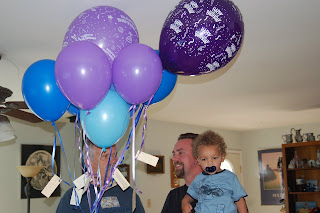
In the afternoon we released balloons. We got two large balloons and seven smaller balloons.
Each balloon had a little card attached with the blog address and a Happy Birthday note on the back. We released them one by one and watched them till they became a tiny dot in the sky. Who knows, maybe someone will find one of the cards an will leave a comment on this blog.
Laurianne's favorite dessert was chocolate cake. Of course we could not pass up the day without indulging in some chocolate cake to celebrate Laurianne's special day.
Loving you is easy,
We do it every day,
Missing you is a heartache,
That never goes away.
Labels: birthday, Laurianne, lung cancer
Posted by Henry (Calem's Opa) ::
10:50 PM ::
---------------------------------------
Thursday, March 22, 2007
This Saturday
Playing for a Cure
Middle & High School Invitational
Band & Classical Solo Competition
 Saturday, March 24, 2007, 9:00 a.m. - 7:00 p.m.
Craigmont Middle School, Memphis, Tennessee
My husband and I will be there! Hope you can make it too!Labels: cancer, events, lung cancer, organizations
Posted by Lynda ::
4:32 AM ::
---------------------------------------
Friday, March 09, 2007
One Year Ago This Month
 Tuesday, March 6 was the anniversary of Dana Reeve's death from lung cancer. I did not fail to notice and wanted to blog about it. I just didn't know what to say.
I am glad there is still some awareness out there because of this disease. She really put lung cancer in the media spotlight. It still makes me angry that people were trying to brush off her death to smoking, because she use to sing in smokey lounges. I admit that second hand smoke could be a factor, but in the long and short of it, anyone can get this disease. Laurianne never sang in smokey lounges.
Hopefully, people continue to be aware of lung cancer. I heard recently of a breath test that has been developed. It shows if you have lung cancer, no matter what stage you are at. It sounded very promising. For those of you in the medical profession, the results were published in the medical journal, Thorax. I still see it on my Google alerts as well, so some news agencies are still talking about it.
Every breakthrough is a step closer to awareness, detection and cure.
Labels: awareness, cancer, lung cancer, organizations
Posted by Lynda ::
7:45 AM ::
---------------------------------------
Tuesday, February 13, 2007
Cancer Stories: Blue's Mom, Sharon
Bluepaintred asked me to post her mom's story on the 10th anniversary of her death. Also, she is going to try to quit smoking for herself. I think that is a great way for her to remember her mom, and I wish her luck!! Also, if you are trying to quit smoking, check out the sidebar. There are some links that may be useful to you.
~oOo~
Maybe, as a smoker myself, I have no right to criticise the lives cancer steals. Or maybe as someone who does smoke, as someone who thought ‘I can quit anytime’, until the first time I tried to quit, I can teach just one person how hard it is to quit. How physically and mentally exhausting it is. How it is not worth it! Maybe I can stop them from lighting up that very first time.
*We do not smoke inside out home*.
I teach my children that smoking is disgusting that it fills my lungs with tar, even my youngest, 2, tells me I smell yucky, and I encourage that… I don’t lie or try to hide my smokers cough from them. I couldn’t bear it if they started. Yet if I had to leave them early, like my mother was forced to leave us, it would hurt so much more.
Today, February 13, 2007, on the tenth anniversary of my mothers’ death, I will put down my cigarettes and try once more to quit. I have failed in the past, but if I keep trying, one day I will succeed.
*************
Sharon Gehon.
May 18, 1954 – February 13, 1997
In September of 1996 my father and I were digging up potatoes in the garden when he told me they found “something” in my mothers’ lung. It all happened very fast from then on; she had a biopsy, which was positive for cancer. I’m not sure the type.
I was seventeen at the time.
My mother hurt her back at work and had me rub it every night. It never seemed to get better, but she did not really think about it.
She had been a long time smoker, and had quit 4..5 (?) years before. I can remember when she was trying to quit, she had a little plastic smoke that she used like a baby would a pacifier. When she was really wanting, she would stick it in her mouth and suck, unfortunately she often forgot, and lit it!
I can’t recall the events very clearly, but some things really stand out in my mind.
Sound. It bothered her a lot when she was in chemo. We, (I have two other siblings, a sister who was 20 and a brother who was 11 at the time), would have to tip toe around, TV was very low and even talking was frowned on.
Smells. They were the worst for her, I think. We had a fridge and a stove down in the basement though, and my dad would cook food down there to help with the smells.
If it’s possible to have a favourite memory of a loved one suffering from chemo, it would be when my mother, sick and tired of hair falling in her food, had me vacuum her head. It occurred to me, much later, that the hair must have been bugging her something awful to have put up with the noise of the vacuum. But hearing her laugh as I tried to get it all… that’s something I cherish.
I got my drivers licence while my mom was in the hospital, I can remember going in to show her it. I was very excited! She looked so tired.
My mothers’ parents came down and stayed with us for a long time. They were there with us in the end.
I was on the phone, down in my room with my then boyfriend when ..my uncle.. my grandpa(?) came and asked me to get off the phone, that dad wanted to call the hospital for a check in. Within minutes all of the adults knew, and I think us kids knew too, that this was it. My dad made it to the hospital in time, and I am happy for that.
I do not remember who told me, or how. That day is very much a blur for me.
It was February 13, 1997, she was 43 years old.
I met my future husband seven months later. Mom never got to meet him. She would have liked him, I think. And when I was pregnant with my first baby, I wanted so badly to ask her about a million questions. There was no way for my dad to know all the stories a mother tells her child.
How big was I? What did I weigh? Was I on time?
I have three boys and they will never know their Grandma Sharon. That, I think is the worst thing of all.
Bluepaintred
Me, Myself and Us - http://redblogblue.blogspot.com/Labels: awareness, cancer, lung cancer, share a story
Posted by Lynda (Laurianne's Sister) ::
7:36 PM ::
---------------------------------------


 Support A Cause

 In Memory of Laurianne


 Lives Lost to Lung Cancer


